If you only buy one pair of headphones for your studio, the open-back vs. closed-back decision will shape almost everything about how you record and mix. Get it backwards - mixing on closed-backs, or tracking vocals on open-backs next to a live mic - and you will fight avoidable problems for the life of your setup. Here is how to choose correctly the first time.
The Core Difference
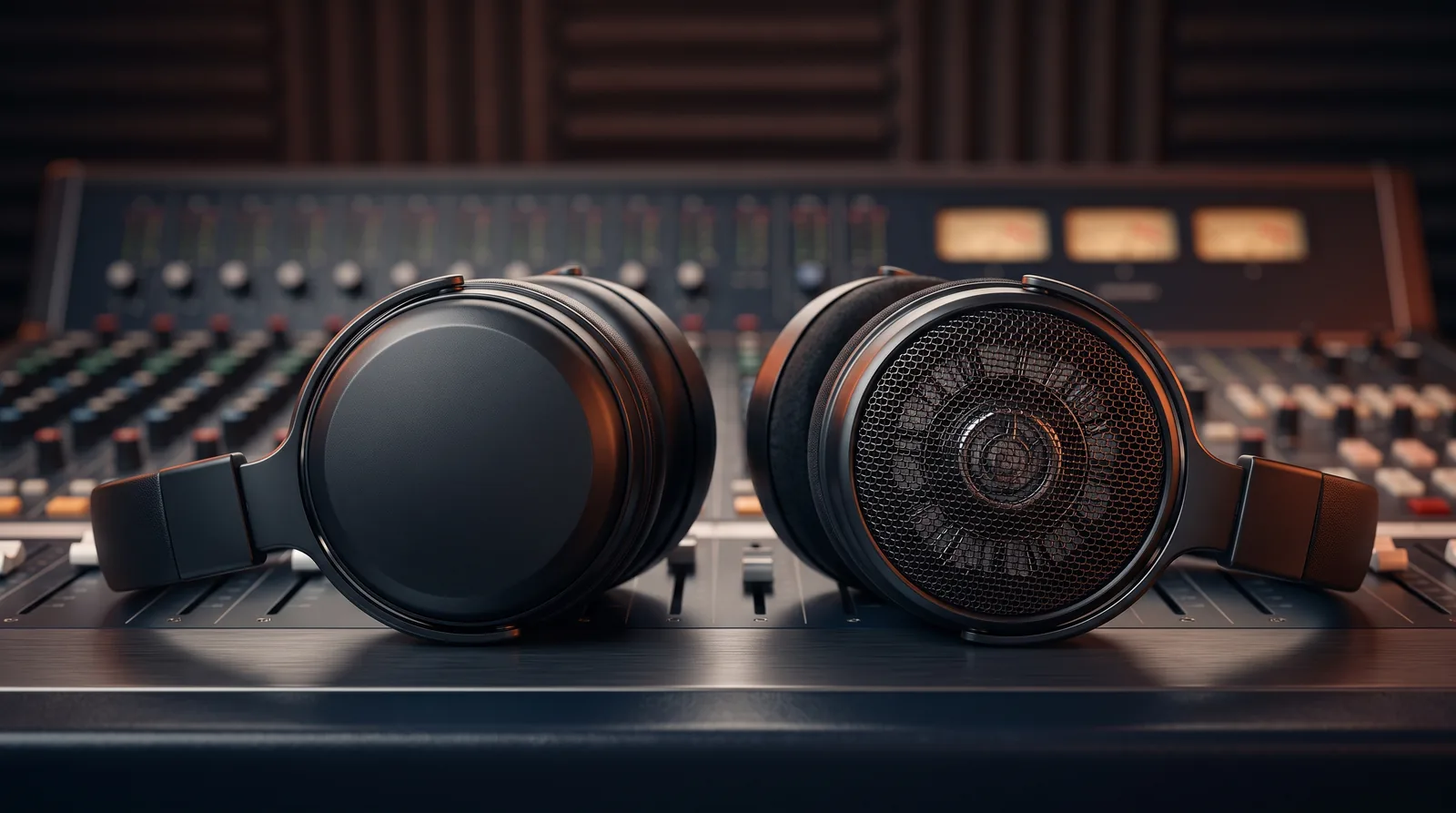
Closed-back headphones have sealed earcups. Sound stays inside the cup and does not leak out (or in), which gives you strong isolation from outside noise and prevents your headphone mix from bleeding into a nearby microphone.
Open-back headphones have perforated or mesh-backed earcups that let air and sound pass through freely. Nothing is sealed in, which removes internal resonance and cup reflections, producing a wider, more natural soundstage (though that also means outside noise gets in, and your headphone signal leaks out).
Neither design is "better" - they are built for entirely different jobs in the studio.
When to Use Closed-Back Headphones
Closed-back models like the Beyerdynamic DT 770 PRO and Austrian Audio Hi-X15 are the industry standard choice for:
- Tracking vocals or acoustic instruments: The sealed cup prevents your headphone click track or reference mix from leaking into a sensitive condenser microphone inches away.
- Recording in untreated or noisy rooms: Passive acoustic isolation blocks out air conditioning hum, street traffic, or household noise common in UAE apartments and villas.
- Live sound and location recording: Isolation from ambient stage or environmental noise is essential when you need to hear exactly what is being captured on tape or disk.
- Drummers and loud sources: Closed-back cans hold up better around high-SPL sources without leaking excessive bleed onto overhead or room mics.
The trade-off: Closed-back designs tend to have a narrower, more "in-your-head" stereo soundstage and can emphasize low-end resonance due to the sealed chamber, making them less reliable for final EQ and stereo-width mastering decisions.
When to Use Open-Back Headphones
Open-back models like the Beyerdynamic DT 990 PRO and DT 1990 PRO MKII are engineered specifically for:
- Mixing and mastering: The open design avoids the internal resonance and acoustic pressure buildup of a sealed cup, giving you a flatter, more linear frequency response and an expansive stereo image.
- Critical listening and reference checks: Panning decisions, stereo width, and subtle micro-EQ adjustments translate more reliably to real-world playback systems when dialed in on open-back cans.
- Long mixing sessions: Most audio engineers find open-back designs significantly more comfortable over 6+ hour sessions, since there is no heat or acoustic pressure trapped against the eardrum.
The trade-off: Because sound passes freely in and out, open-backs are unusable in a live room with an active microphone nearby, and they offer zero isolation from room noise.
Quick Decision Table
| Situation / Use Case | Recommended Architecture |
|---|---|
| Tracking vocals or instruments near a live mic | Closed-Back |
| Mixing or mastering a finished recording | Open-Back |
| Recording in a noisy UAE apartment without acoustic panels | Closed-Back |
| Long critical-listening or mastering sessions | Open-Back |
| Location recording or live sound FOH monitoring | Closed-Back |
| Reference checking stereo imaging and reverbs | Open-Back |
Do You Need Both?
If you are serious about both recording and mixing, yes: most professional studios keep at least one pair of each. A practical UAE studio setup:
- Beyerdynamic DT 770 PRO (80Ω or 250Ω): Dedicated for tracking, booth monitoring, and isolation work.
- Beyerdynamic DT 990 PRO / DT 1990 PRO MKII (250Ω): Dedicated for mixing console, critical EQ, and mastering checks.
If budget only allows for one pair right now, choose based on what you do more often: if you are mostly recording vocals, podcasts, or instruments, start closed-back. If you are primarily mixing tracks you or a client already recorded, start open-back.
A Note on Ohm Ratings and Amplification
Higher-impedance headphones (250Ω and above, common in pro open-back models) need a dedicated headphone amplifier or an audio interface with sufficient output voltage (such as an RME Babyface Pro FS or ADI-2 DAC FS) to drive them cleanly. Plugging 250Ω cans directly into a laptop jack will sound noticeably quiet and bass-anemic.
Frequently Asked Questions
Can I mix on closed-back headphones if that is all I have?
You can get usable results, but closed-back cups often exaggerate sub-bass resonance, which can lead to mixes that sound thin on other consumer systems. Regularly cross-reference your mix on studio monitors or earbuds before finalizing.
Are open-back headphones bad for use in shared spaces?
Yes: because sound leaks freely out of the earcups, open-back headphones are clearly audible to people sitting nearby, making them unsuitable for shared office desks or quiet bedrooms.
What is the difference between the DT 990 PRO and DT 1990 PRO MKII?
The DT 990 PRO is an established, high-value open-back reference headphone with crisp treble detail. The DT 1990 PRO MKII is a flagship mastering tool featuring Tesla neodymium drivers, detachable mini-XLR cables, and dual interchangeable acoustic pads (Balanced vs Analytical).